
Author

admin

Browsing

This week, the technology sector remained the dominant force shaping overall market trends in the US, despite the ongoing complexity of macroeconomic and geopolitical conditions.

The partial US government shutdown continued to delay key economic reports, creating a data vacuum that heightened reliance on soft data like consumer sentiment surveys. Notably, the University of Michigan’s Consumer Sentiment Index held steady at a subdued 55, reflecting persistent concerns about high prices and a challenging labor market.

Meanwhile, Canada reported a surprising gain of 60,400 jobs in September, with employment increases concentrated in full-time positions and manufacturing. The unemployment rate held steady at 7.1 percent, defying expectations and signaling a cautious stabilization after recent job losses.

Investor appetite for AI and related innovation remained high, pushing the Nasdaq Composite (INDEXNASDAQ:.IXIC) and S&P 500 (INDEXSP:.INX) to record or near-record levels midweek. However, ongoing trade frictions between the US and China continue posing risks to semiconductor supply chains and international tech trade flows.

On Friday (October 10), China introduced additional export restrictions on rare earth metals and related refining technologies, expanding controls to five more elements critical for electronics, defense and high-tech industries. US President Donald Trump responded by threatening to escalate tariffs on Chinese imports and warned of the potential cancellation of his upcoming meeting with President Xi Jinping at APEC in South Korea.

The news sent major stock indexes lower, with the S&P 500 seeing its largest decline since tariffs were first announced in April and the Nasdaq Composite losing 3.56 percent. The Philadelphia SE Semiconductor Index led losses, pulling back 6.32 percent.

After a nearly three-year rally fueled by enthusiasm for AI, concerns among analysts and investors about elevated valuations and concentrated exposure in AI-related companies continue to emerge.

The Bank of England’s Financial Policy Committee warned of an increased risk of market correction, particularly in AI-focused tech firms, due to stretched valuations. They noted high market concentration in the S&P 500’s top five companies, many being AI-centric. Disappointing AI adoption or increased competition could trigger a downturn by reassessing high earnings expectations. Bottlenecks in AI advancements also pose valuation risks.

Similarly, IMF Managing Director Kristalina Georgieva warned that AI-fueled global stock prices are overvalued and vulnerable to a sudden correction. She cited weakening job creation and US tariffs as “troubling signs” that could lead to instability and dampen global growth.

Analysts from JPMorgan Chase & Co. (NYSE:JPM) also wrote in a Monday (October 6) note that AI-related debt has reached US$1.2 trillion, making it the largest segment in the investment-grade market. AI companies now represent 14 percent of the high-grade market, exceeding US banks. However, this debt is primarily in investment-grade bonds from companies with strong balance sheets,

This complex interplay of cautious optimism underscores the evolving narratives dominating the tech market.

Three tech stocks that moved markets this week

1. Advanced Micro Devices (NASDAQ:AMD)

AMD’s stock opened over 31 percent higher on Monday after announcing a multi-year deal to supply up to 6 gigawatts of AI chips to OpenAI, starting with its MI450 series in the second half of 2026.

The company extended its gains on Tuesday (October 7) after Jefferies upgraded the stock rating to “buy” as other brokerages hiked their price targets. The news helped temper losses seen throughout the tech sector as trade tensions escalated on Friday.

The partnership grants OpenAI warrants to acquire up to 160 million shares of AMD, representing around 10 percent ownership upon achieving deployment milestones. This deal positions AMD as a major AI hardware supplier and represents a challenge to Nvidia’s dominance in the sector.

2. Intel (NASDAQ:INTC)

Intel shares jumped as much as 3.05 percent on Friday after the company unveiled its Panther Lake architecture, the first PC processor built on its advanced 18A semiconductor manufacturing process, with high-volume production beginning later this year at its Fab 52 facility in Arizona.

Panther Lake is set to significantly enhance power efficiency and performance, delivering an anticipated 50 percent increase in CPU and GPU capabilities compared to earlier generations. This chip is designed for premium laptops and is central to Intel’s plan to re-establish its leadership in semiconductor manufacturing within the US.

Intel also previewed its first 18A-based server processor, Clearwater Forest, slated for release in the first half of 2026. Panther Lake is scheduled for commercial availability in early 2026, coinciding with major consumer electronics shows.

3. Tesla (NASDAQ:TSLA)

Tesla released the long-awaited lower-priced versions of the Model Y and Model 3 on Tuesday, with the Model Y Standard starting at US$39,990.

After an initial rally on Monday following a weekend teaser of the announcement, shares fell by as much as 4.57 percent after an underwhelming reaction to modest price cuts and the vehicles’ lack of key features present in the pricier models.

The company also reportedly paused large-scale production of its humanoid robot Optimus due to technical difficulties and faced a new preliminary safety investigation by the NHTSA into its Full Self-Driving system, covering nearly 2.9 million vehicles amid reports of traffic law violations.

Company announcements helped Intel and AMD weather sector-wide losses on Friday

Chart courtesy of Google Finance

ETF performance

This week, the iShares Semiconductor ETF (NASDAQ:SOXX) only declined by about 6.27 percent, while the Invesco PHLX Semiconductor ETF (NASDAQ:SOXQ) pulled back by approximately 6.49 percent.

For its part, the VanEck Semiconductor ETF (NASDAQ:SMH) only lost 5.86 percent.

These losses occurred against a backdrop of heightening trade tensions between tech’s two largest markets.

Other tech market news

            Tech news to watch next week

            Next week, investors will be closely monitoring a slate of important earnings reports from leading financial and technology companies, including JPMorgan Chase, Bank of America Corp (NYSE:BAC), Goldman Sachs (NYSE:GS), Morgan Stanley (NYSE:MS), IBM, Intel and Tesla.

            Additionally, the US government’s shutdown resolution or extension will affect the release of vital economic data, influencing market sentiment and investment strategies.

            On the policy front, investors should watch for Federal Reserve communications for clues on interest rate directions, as well as progress in US-China trade negotiations, which will undoubtedly define the near-term trajectory of the tech market.

            Securities Disclosure: I, Meagen Seatter, hold no direct investment interest in any company mentioned in this article.

            This post appeared first on investingnews.com

            Here’s a quick recap of the crypto landscape for Friday (October 10) as of 9:00 a.m. UTC.

            Get the latest insights on Bitcoin, Ether and altcoins, along with a round-up of key cryptocurrency market news.

            Bitcoin and Ether price update

            Bitcoin (BTC) was priced at US$121,578, down by 1.6 percent in 24 hours. The cryptocurrency’s lowest valuation of the day was US$119,967, and its highest was US$123,548.

            Bitcoin price performance, October 10, 2025.

            Chart via TradingView

            Bitcoin may be trading near record highs, but one of its most respected on-chain indicators suggests the rally could still have significant room to run possibly as far as US$180,000.

            The Mayer Multiple, a long-term metric that compares Bitcoin’s current price to its 200-week moving average, remains well below levels that have historically marked market tops.

            “Bitcoin is at all-time highs and the Mayer Multiple is ice cold,” crypto analyst Frank Fetter wrote on X (formerly Twitter). According to Fetter, Bitcoin would need to climb to around US$180,000 before the indicator flashes “overbought” conditions, implying that the current cycle could still have room to expand.

            The indicator’s historical context adds weight to that view. During Bitcoin’s 2017 and 2021 peaks, the Mayer Multiple surged well above 2.4, signaling excessive market exuberance before major corrections followed.

            This time, the pattern looks different. The Multiple’s highest level in the current cycle—1.84 in March 2024, when Bitcoin neared US$72,000—never approached prior extremes, according to Glassnode data. Analysts see this moderation as a sign of a more sustainable advance.

            Despite these encouraging on-chain signals, not everyone is convinced the path higher will be smooth. Short-term traders remain divided on whether Bitcoin can maintain momentum into the final quarter of the year.

            Trader Tony “The Bull” Severino argued that Bitcoin may be entering a decisive 100-day window. Writing on X, Severino pointed to the Bollinger Bands indicator on Bitcoin’s weekly chart, which has tightened to levels not seen before. He noted that Bitcoin’s recent inability to hold above US$126,000, after briefly testing the upper band, could signal a short-term pullback before any sustained breakout.

            Ether (ETH) also slid after last week’s rally, but has since recovered some of its losses. It was up by 0.7 percent over 24 hours to US$4,365.58. Ether’s lowest valuation on Friday was US$4,285.77, and its highest was US$4,401.99.

            Altcoin price update

            • Solana (SOL) was priced at US$222.58, an increase of 1.1 percent over the last 24 hours and its highest valuation of the day. Its lowest valuation on Friday was US$217.57.
            • XRP was trading for US$2.83, trading flat over the last 24 hours. Its lowest valuation of the day was US$2.78, and its highest was US$2.84.

            Derivatives trends

            The crypto derivatives market saw heavy liquidations over the past 24 hours, totaling roughly US$674 million, according to Coinglass data. Long positions accounted for US$505 million of that amount, while short positions made up US$169 million, marking one of October’s sharpest liquidation waves.

            Among major assets, Bitcoin long liquidations reached US$116 million, compared to US$68.22 million in shorts, indicating that overleveraged bullish traders bore the brunt of the latest downturn. Ether long positions were liquidated for US$146 million, against US$34.54 million in shorts, reflecting a similar shakeout of optimistic bets amid heightened volatility.

            Despite the sell-off, futures open interest for Bitcoin rose 0.23 percent in the last four hours to US$90.19 billion, suggesting that traders are gradually re-entering positions or maintaining leverage at elevated levels.

            Ether futures open interest also ticked up 0.22 percent to US$59.53 billion, showing that market participants remain engaged even after widespread liquidations.

            Bitcoin’s relative strength index (RSI) at 72.15 indicates that the asset remains in overbought territory, potentially signaling near-term price swings or corrective moves. Still, the market’s resilience near the US$120,000 level points to continued speculative interest.

            Today’s crypto news to know

            XRP, DOGE, SOL slip as US$2.7 billion flows into Bitcoin ETFs

            Major altcoins faced losses Friday as traders took profits from Bitcoin’s record-breaking rally, even as spot ETF demand remained strong.

            Bitcoin briefly dipped to around US$120,000 overnight before stabilizing near US$122,000, while Ether erased its weekly gains with a 2.4 percent drop.

            Solana, XRP, Dogecoin, and Cardano each slid up to 3 percent, according to CoinDesk data. Despite the retreat, US-listed Bitcoin ETFs drew US$2.72 billion in inflows this week, highlighting resilient institutional appetite.

            The ETF surge underscores Bitcoin’s growing role as a “digital safe-haven,” especially as gold surged above Us$4,000 an ounce. However, a possible pullback to the US$107,000–US$115,000 range could be imminent ahead of the Federal Reserve’s October 29 policy meeting.

            EU dismisses ECB’s call for new stablecoin rules

            The European Commission said Friday that existing crypto regulations under MiCA are adequate to handle stablecoin risks, pushing back on calls from the European Central Bank for stricter oversight.

            According to a Reuters report, the ECB had urged Brussels to introduce new safeguards against “multi-issuance” models, where stablecoins minted outside the EU could be treated as interchangeable with those issued within.

            Industry groups, including members like Circle, asked the Commission to formally clarify that multi-issuance is allowed under current rules.

            In a statement to Reuters, the Commission said MiCA already provides a “robust and proportionate framework” and that further guidance will be published soon.

            The ECB’s main concern is that redemptions from non-EU tokens could drain reserves inside the bloc, posing systemic risks. Stablecoin issuers countered that their reserve structures already mitigate such threats.

            Bitcoin ETFs extend Uptober gains as Ethereum products lose momentum

            US spot Bitcoin ETFs posted another strong day Tuesday, with US$197.8 million in net inflows, reinforcing Bitcoin’s dominance as institutional investors rotated away from Ethereum products.

            Data from SoSoValue showed total Bitcoin ETF assets climbing to US$164.79 billion, representing nearly 7 percent of Bitcoin’s market cap.

            BlackRock’s iShares Bitcoin Trust (NASDAQ:IBIT) led inflows with US$255 million, extending its lead over rivals as total assets surpassed $97 billion. Fidelity Wise Origin Bitcoin Fund (BATS:FBTC) and Grayscale Bitcoin Trust (NYSEARCA:GBTC) saw outflows of US$13 million and US$45 million, respectively.

            The renewed demand follows a surge of US$1.19 billion in inflows earlier this week, the highest since July, with BlackRock again accounting for the majority.

            Bitcoin has gained over 10 percent in October, peaking at US$126,080 before easing to $121,000. Meanwhile, Ethereum ETFs snapped their eight-day inflow streak with US$8.7 million in withdrawals, reflecting a temporary pause after a strong start to the month.

            Securities Disclosure: I, Meagen Seatter, hold no direct investment interest in any company mentioned in this article.
            Securities Disclosure: I, Giann Liguid, hold no direct investment interest in any company mentioned in this article.
            This post appeared first on investingnews.com

            The government shutdown is poised to enter a third week, and Democrats still appear to be struggling in the search for a cohesive messaging strategy.

            Senate Minority Leader Chuck Schumer, D-N.Y., received a barrage of GOP-led attacks on Thursday after he told Punchbowl News, ‘Every day gets better for us’ in reference to the shutdown dragging on.

            Meanwhile, House Democrats’ group selfie taken on Sept. 29, just before the shutdown, received criticism from both sides of the aisle. Former Rep. Adam Kinzinger, R-Ill., who’s become a fierce critic of the GOP since leaving office, wrote on X, ‘These selfie things need to stop guys. Honestly, the democrats were great at social media but social media moved on from them. The kitschy, goofy ‘choose your fighter’ type stuff needs to stop.’

            Democrats have been fighting to center the discussion on healthcare, and their argument that any deal to reopen the federal government must at least include an extension of COVID-19 pandemic-era enhanced Obamacare subsidies that are set to expire at the end of this year.

            And while polls show that Americans overwhelmingly do support extending the subsidies, surveys taken of the government shutdown have been more mixed, with a significant number of Americans blaming both parties.

            A new Reuters/Ipsos poll released on Wednesday showed 67% of Americans believe Republicans deserve ‘a fair amount or a great deal of blame’ for the shutdown, compared to 63% for Democrats.

            A New York Times/Siena poll taken on the eve of the shutdown showed that Democrats had a similarly thin edge over the GOP in the shutdown fight, but that 65% of people did not believe Democrats should shut down the government if their demands were not met.

            ‘Democrats keep choosing the wrong fights, including the shutdown fight. At best, the shutdown will give them a political draw where the public will blame both parties,’ Julian Epstein, a former Democratic staffer for the House Judiciary Committee, told Fox News Digital.

            ‘But they will not get a game change out of this conflict, and the risk for them is the longer it goes on, the public will see it’s the Democrats who are narcissistically voting to shut down the government after losing the election.’

            During an appearance on ‘Real Time With Bill Maher’ earlier this month, CNN political commentator and former Obama administration appointee Van Jones said Democrats ‘do the wrong thing at the wrong time for the right reason.’

            Jones said he was in favor of extending the Obamacare subsidies but argued that it may have been folly for his party to pick that fight over the shutdown before people even got notice of their premiums potentially rising.

            ‘I get it, the base is upset … ’Please do something, do anything,’ but the ‘something’ probably shouldn’t be throwing a bunch of people out of work in the federal government and crushing the American government’s ability to function right before the pain was about to start,’ he said.

            And it’s not yet clear if Democrats have an agreed-upon roadmap for how to navigate the shutdown yet.

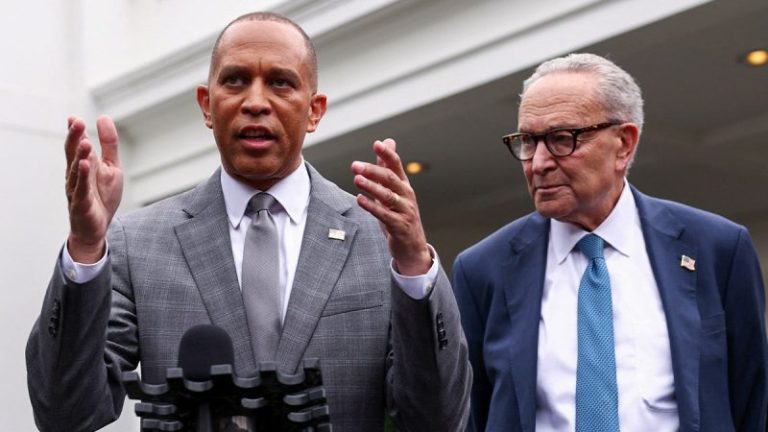
            Late last week, just before Speaker Mike Johnson, R-La., announced that the House would be out of session for another week while Republicans’ funding bill stalled in the Senate, House Minority Leader Hakeem Jeffries, D-N.Y., unequivocally told Fox News Digital that ‘yes,’ he would call all House Democrats back to Washington to draw a contrast between the two sides.

            He walked that back somewhat on Monday, however. When asked by Fox News Digital if he would still call the full caucus back, Jeffries said, ‘We have a caucus meeting at 6 p.m. today. We’ll have a House Democratic Caucus leadership meeting, that’s the full leadership, tomorrow. And I expect a strong presence of House Democrats throughout here in Washington.’

            What he did not specify, however, was that the 6 p.m. caucus meeting was virtual.

            At another press conference this week, Jeffries called a one-year Obamacare subsidy extension compromise bill ‘laughable’ despite it getting support from 11 members of his own Democratic caucus.

            He walked those comments back again, ‘If anything is presented to us, of course, the caucus will consider it in good faith.’

            But Republicans have also garnered their share of public criticism for shutdown messaging as well.

            President Donald Trump’s aggressive rhetoric on federal employee layoffs put congressional Republicans in a difficult position earlier this month, though Trump has since softened his language and not yet carried out those firings.

            The White House’s depiction of Jeffries in a sombrero on multiple occasions has also been panned as racist by critics.

            Mike Nellis, a Democratic strategist and founder of campaign consulting firm Authentic, said Democrats were doing the right thing in focusing on health care while criticizing Republicans’ messaging.

            ‘I think that focusing on the health care subsidies, which are undeniably popular, has been a really smart thing for Democrats to do,’ Nellis told Fox News Digital.

            ‘I think that the Republicans have played right into their worst tendencies on this, which is, much of their messaging is aggressively online-focused. The sombrero stuff is mildly funny. But then they went all in on it, and they don’t have a good answer to the health care subsidies.’

            Nellis also argued that Republicans’ touting of a ‘landslide’ electoral victory has set them up for a larger share of the blame.

            ‘When you create the conditions where you talked about the mandate that you have and the government shuts down on your watch, you’re responsible for the government shutdown,’ he said.

            Still, he said he would grade Democrats with a ‘B, B minus’ on their messaging, adding that it’s ‘not perfect.’

            ‘Maybe the answer is … Republicans are losing the shutdown fight, rather than Democrats are winning it,’ Nellis said. ‘But I mean, I just think we’ve got a lot more right than a lot more wrong, which is the first time you can say that in quite a while.’

            This post appeared first on FOX NEWS

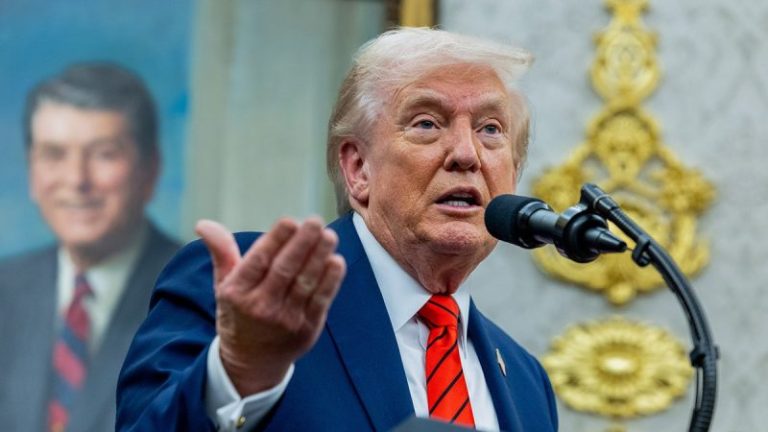
            President Donald Trump is in ‘excellent overall health,’ the president’s doctor said in a memorandum after a follow-up evaluation at Walter Reed National Military Medical Center on Friday. 

            Earlier this week, the White House announced that Trump, 79, would undergo a ‘routine’ semiannual physical on Friday. 

            The president also met with troops while at the hospital in Bethesda, Maryland. 

            ‘President Donald J. Trump successfully completed a scheduled follow-up evaluation at Walter Reed National Military Medical Center,’ Navy Capt. Sean P. Barbabella, the physician to the president, wrote in a memorandum to White House press secretary Karoline Leavitt. 

            Barbabella said that the visit was part of an ongoing health maintenance plan that included ‘advanced imaging, laboratory testing and preventative health assessments conducted by multidisciplinary team of specialists.’ 

            He added, ‘Comprehensive laboratory studies performed in conjunction with the visit were exceptional, including stable metabolic, hematologic and cardiac parameters.’

            In his summary, Barbabella said Trump, ‘remains in exceptional health, exhibiting strong cardiovascular, pulmonary, neurological, and physical performance.’ 

            Barbabella also said Trump also received updated COVID-19 and flu shots in preparation for international travel. 

            ‘President Trump continues to demonstrate excellent overall health,’ he wrote, adding that his cardiac age was found to be ‘approximately 14 years younger than his chronological age. He continues to maintain a demanding daily schedule without restriction.’ 

            The medical checkup will be Trump’s second this year. He had a similar exam in April, during which his physician stated that he ‘remains in excellent health.’

            In July, the president was diagnosed with a vein condition known as chronic venous insufficiency. At the time, Leavitt said Trump had noticed ‘mild swelling’ in his lower legs and was evaluated by the White House medical unit.

            Chronic venous insufficiency occurs when veins in the legs struggle to allow blood to flow back up to the heart.

            Leavitt attributed the bruising on the president’s hand to ‘frequent handshaking and the use of aspirin.’

            This post appeared first on FOX NEWS

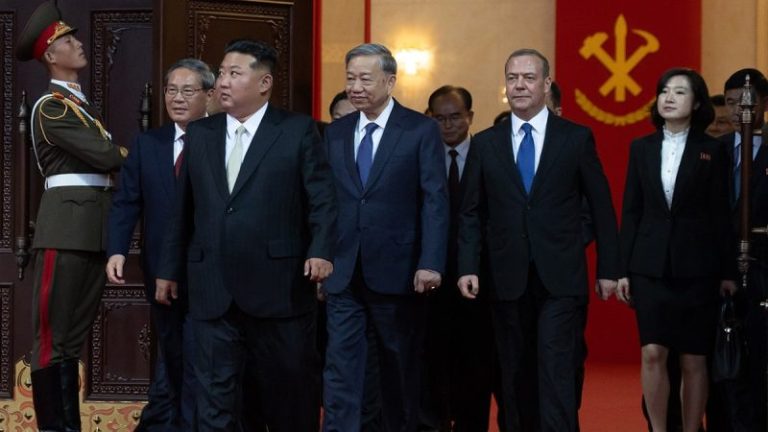
            North Korean leader Kim Jong Un displayed a new long-range intercontinental ballistic missile at a military parade in Pyongyang that included foreign leaders on Friday. 

            The yet-to-be-tested Hwasong-20 was described by the state-owned Korean Central News Agency as having the ‘most powerful nuclear strategic weapons system.’

            The government also displayed shorter-range ballistic, cruise and supersonic missiles at the military parade, which marked 80 years since the founding of the Worker’s Party.

            Kim said at the parade that the military ‘must continue to evolve into an invincible force that eliminates all threats.’

            The foreign dignitaries at the parade included Chinese Premier Li Qiang, former Russian President Dmitry Medvedev, and Vietnam’s Communist Party chief To Lam. 

            Kim also met with Medvedev on Friday, who praised the sacrifice of North Korean soldiers fighting with Russia in Ukraine. 

            Kim said he hoped to strengthen ties with Russia and work together toward common goals. 

            Last summer, Kim’s sister Kim Yo Jong warned the U.S. to not attempt to restart talks centered around denuclearization, adding that Pyongyang would view any attempt to pressure North Korea to denuclearize as ‘nothing but a mockery.’ 

            ‘If the U.S. fails to accept the changed reality and persists in the failed past, the DPRK- U.S. meeting will remain as a ‘hope’ of the U.S. side,’ Kim Yo Jong said, referring to the nation by its official name, the Democratic People’s Republic of Korea.

            The Associated Press and Reuters contributed to this report. 

            This post appeared first on FOX NEWS

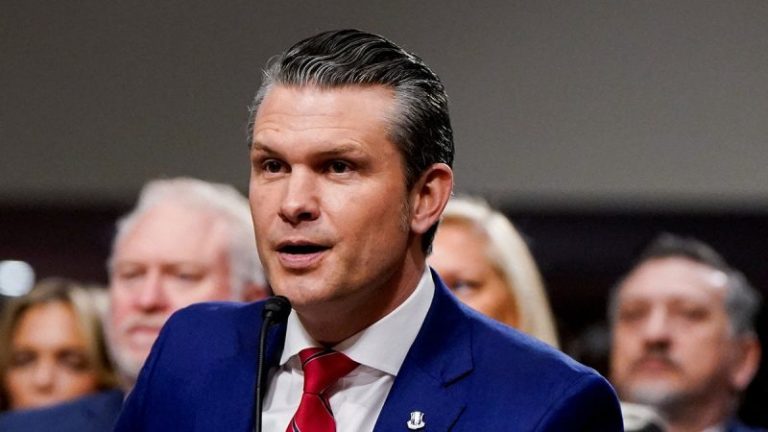
            Secretary of War Pete Hegseth on Friday announced that the Department of War (DOW) is establishing a new counter-narcotics Joint Task Force in the Caribbean Sea. 

            Hegseth said the task force’s aim would be to ‘crush the cartels, stop the poison, and keep America safe. The message is clear: if you traffic drugs toward our shores, we will stop you cold.’

            The task force is launching at the direction of President Donald Trump, he said, in the SOUTHCOM area, which covers the Caribbean and Latin America. 

            The U.S. Southern Command said in a release that the task force was being launched under the II Marine Expeditionary Force on Friday ‘to synchronize and augment counter-narcotics efforts across the Western Hemisphere.’

            ‘Transnational criminal organizations threaten the security, prosperity, and health of our hemisphere,’ Admiral Alvin Holsey, the commander of SOUTHCOM, said in a statement. ‘By forming a JTF around II MEF headquarters, we enhance our ability to detect, disrupt, and dismantle illicit trafficking networks faster and at greater depth – together with our U.S. and partner-nation counterparts.’

            This comes as the administration has begun strikes against boats in the Caribbean it says are linked to drug trafficking networks.

            The administration has conducted a series of fatal strikes against four small boats believed to be carrying drugs over the last few months.

            It said 21 people were killed in the strikes.  

            The attacks have alarmed Democratic lawmakers as the administration hasn’t detailed what evidence it had against the targeted boats or their passengers. 

            This post appeared first on FOX NEWS

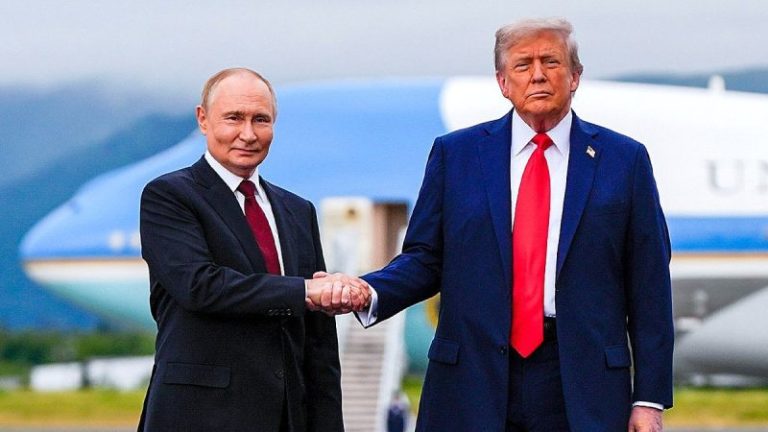
            Russian President Vladimir Putin praised President Donald Trump’s efforts to negotiate peace deals around the world, specifically citing his work brokering a truce between Israel and Hamas.

            ‘He’s really doing a lot to resolve such complex crises that have lasted for years and even decades,’ Putin said at a summit in Dushanbe, Tajikistan, where he met with leaders of nations once part of the former Soviet Union.

            The remarks came in response to a question about whether he felt Trump had been passed over for the Nobel Peace Prize.

            The award was given Friday morning to Venezuelan opposition leader and democracy activist María Corina Machado.

            ‘There have been cases where the committee has awarded the Nobel Peace Prize to people who have done nothing for peace,’ Putin said. ‘A person comes — good or bad — and [gets it] in a month, in two months — boom. For what? He didn’t do anything at all.

            ‘In my view, these decisions have done enormous damage to the prestige of this prize,’ he continued.

            In September, Trump alluded to the likelihood that he would again be passed over for the Nobel Prize despite helping to end several conflicts.

            ‘If this works out, we’ll have eight — eight in eight months. That’s pretty good,’ Trump said during remarks to dozens of top generals and admirals in Quantico, Virginia. ‘Nobody’s ever done that. Will you get the Nobel Prize? Absolutely not.

            ‘They’ll give it to some guy that didn’t do a damn thing,’ he continued. ‘They’ll give it to the guy who wrote a book about the mind of Donald Trump and what it took to solve the wars. The Nobel Prize will go to a writer.’

            This post appeared first on FOX NEWS

            HONG KONG — China outlined new curbs on exports of rare earths and related technologies on Thursday, extending controls over use of the elements critical for many high-tech and military products ahead of a meeting in about three weeks between President Donald Trump and Chinese leader Xi Jinping.

            The regulations announced by the Ministry of Commerce require foreign companies to get special approval to export items that contain even small traces of rare earths elements sourced from China. These critical minerals are needed in a broad range of products, from jet engines, radar systems and electric vehicles to consumer electronics including laptops and phones.

            Beijing will also impose permitting requirements on exports of technologies related to rare earths mining, smelting, recycling and magnet-making, it said.

            China accounts for nearly 70% of the world’s rare earths mining. It also controls roughly 90% of global rare earths processing. Access to such materials is a key point of contention in trade talks between Washington and Beijing.

            As Trump has raised tariffs on imports of many products from China, Beijing has doubled down on controls on the strategically vital minerals, raising concerns over potential shortages for manufacturers in the U.S. and elsewhere.

            It was not immediately clear how China plans to enforce the new policies overseas.

            During a cabinet meeting Thursday, Trump said he had yet to be briefed on the new rules but suggested that the U.S. could stop buying Chinese goods. “We import from China massive amounts,” Trump said. “Maybe we’ll have to stop doing that.”

            Neha Mukherjee, a rare earths analyst at Benchmark Mineral Intelligence, called the new export controls “a strategic move by China that mirror some of Washington’s new chip export rules.

            “Most rare earth magnet manufacturers in the U.S., Japan and elsewhere remain heavily dependent on rare earths from China, so these restrictions will force some difficult decisions — especially for any company involved in military uses of rare earths because most of those export licenses are expected to be denied, he said.

            “The message is clear: if the U.S. and its allies want supply chain security, they must build independent value chains from mine to magnet,” Mukherjee said.

            The new restrictions are to “better safeguard national security” and to stop uses in “sensitive fields such as the military” that stem from rare earths processed or sourced from China or from its related technologies, the Commerce Ministry said.

            It said some unnamed “overseas bodies and individuals” had transferred rare earths elements and technologies from China abroad for military or other sensitive uses which caused “significant damage” to its national security.

            The new curbs were announced just weeks ahead of an expected meeting between Trump and Chinese President Xi Jinping on the sidelines of the Asia-Pacific Economic Cooperation forum in South Korea, that begins at the end of this month.

            “Rare earths will continue to be a key part of negotiations for Washington and Beijing,” George Chen, a partner at The Asia Group, said in an emailed comment. “Both sides want more stability but there will be still a lot of noises before the two leaders, President Trump and Xi, can make a final deal next year when they meet. Those noises are all negotiation tactics.”

            These new restrictions will likely prompt additional government and private investments in developing a mine-to-magnet supply chain outside of China. Mukherjee said that $520 million of investments in the American rare earths industry were announced just in the second quarter with most of that coming from the government.

            And there is some progress already being made with American magnet maker Noveon announcing an agreement with Lynas Rare Earths this week to secure a supply of rare earths outside of China from Lynas’ mine in Australia, and MP Materials preparing to begin producing magnets later this year at its new plant in Texas that uses rare earths from the only U.S. mine that it operates in California.

            In July, the U.S. Defense Department agreed to invest $400 million in shares of the Las Vegas company, establish a floor for the price of key elements, and ensure that all of the magnets made at a new plant in the first 10 years are purchased.

            An MP Materials spokesperson said China’s action “reinforces the need for forward-leaning U.S. industrial policy. Building resilient supply chains is a matter of economic and national security.”

            Wade Senti, president of the U.S. permanent magnet company AML, said it’s time to innovate.

            “The game of chess that China is playing underscores the importance of developing innovation that changes the game and puts the United States in leading position,” Senti said.

            Nazak Nikakhtar, a former Commerce Department undersecretary, said the new restrictions are “a significant development and escalation” by extending controls to related technology and equipment and to sectors like chipmakers. “This should be a wake-up call to the U.S. government that we need to invest in and appropriate more to domestic capabilities. Both are critical to rebuild America’s rare earths industrial base,” she said.

            In April, Chinese authorities imposed export curbs on seven rare earth elements shortly after Trump unveiled his steep tariffs on many trading partners including China.

            While supplies remain uncertain, China approved some permits for rare earth exports in June and said it was speeding up its approval processes.

            This post appeared first on NBC NEWS

            Perth, Australia (ABN Newswire) – Locksley Resources Ltd (ASX:LKY,OTC:LKYRF) (FRA:X5L) (OTCMKTS:LKYRF) announces a major advancement at its Mojave Project in California. Recent structural mapping has dramatically expanded the target mineralised corridor at the Desert Antimony Mine (DAM) Prospect and identified a parallel structural target, enhancing the potential for a larger mineralised system across multiple mineralised zones. This expanded target has the potential to strengthen Mojave’s position as a strategic U.S. critical minerals hub, aligned with accelerating domestic supply-chain initiatives.

            Highlights

            – Structural mapping expands target mineralised corridor at Desert Antimony Mine (DAM) fourfold to 1.2 km, dramatically increasing the exploration target footprint and scale potential

            – New parallel structural target zone identified 150m west of the main DAM structure, indicating the potential for a multi-zone system

            – Updated 3D geological model defines seven priority follow up surface sampling targets, supporting imminent exploration targeting and JORC Exploration Target work

            – Regional mapping identifies lamprophyre dykes, highlighting potential for additional critical mineral occurrences including carbonatites

            – Mojave emerging as a district-scale critical minerals hub, strategically aligned with accelerating U.S. onshoring policies

            – Third phase structural mapping program to commence late November to continue building geological understanding of the project and identify new targets

            – High-grade silver assays up to 216 g/t Ag returned from Hendricks Prospect, alongside anomalous Zn, Pb, and Cu, indicating a broader polymetallic system

            The structural geology mapping completed in late August/September 2025 at the Mojave Project has expanded the strike extent of the target structure at the Desert Antimony Mine (DAM) Prospect from 0.3 km to 1.2 km, representing a ~400% increase and highlighting the potential of the system. Mapping confirmed the continuity of the NNE-striking structural zone that hosts high-grade stibnite mineralisation at DAM, and identified a second, parallel shear zone, approximately 150 m to the west, exhibiting similar alteration and structural characteristics.

            The updated geological interpretation also highlights steep north-plunging intersections between the mapped shear zones and folded host rocks as possible mineralisation plunge controls. Collectively, these findings have been incorporated into a new 3D geological model, which has defined seven priority surface sampling targets to guide the next phase of exploration and support the development of a JORC Exploration Target to guide future drilling programs.

            The scale and geometry of these target zones align with the type of high-grade, clean stibnite feedstock required to fast-track U.S. antimony supply chains under programs such as DPA Title III and DOE ARPA-E. The program, undertaken by a specialist structural geologist, delivered five key outcomes:

            – Significant expansion of geological mapping to the northeast and southwest of the DAM Prospect, extending the target horizon to 1.2 km of strike and materially increasing the scale potential of the mineralised system.

            – Completion of new geological maps for the Hendricks Prospect (2.5km south east of DAM) and the Junipero Prospect (1.1km north of the Mountain Pass Mine).

            – Identification of multiple lamprophyre dykes across all areas mapped suggest the presence of deepseated mantle tapping structures.

            – Updated 3D geological models across the claim package, providing enhanced structural understanding and supporting refined exploration targeting

            – Definition of 18 priority target areas for follow-up detailed mapping and intensive sampling programs to further assess mineralisation potential (to commence in October).

            Desert Antimony Mine (DAM)

            Mapping at DAM focussed on extending to the NE and SW from the previous mapping campaign, resulting in a comprehensive geological map now covering ~1.8km of strike and the development of an updated 3D geological model (Figure 1*). This work has significantly enhanced the understanding of the structural framework and potential controls to mineralisation. Key highlights from mapping and modelling in this area include:

            – Confirmation of continuity of the structural zone (which is host to the mineralisation at DAM) for approximately 400m NNE from the existing adits.

            – Identification of a second parallel structural zone located approximately 150m west of the main mineralised trend, exhibiting a comparable alteration signature and kinematics to that seen at DAM.

            – Extension of the target mineralisation corridor to ~1.2km (previously ~0.3km) representing a ~400% increase in strike length.

            – Improved understanding of mineralisation controls, particularly the role of steep north plunging intersections between mapped shears and folded host rocks.

            – Definition of seven priority areas for detailed follow up sampling and mapping to refine exploration targeting.

            – Enhanced structural interpretation, revealing clear associations between E-W trending stratigraphy and regional fold hinges and NNE striking shear zones, critical for targeting additional mineralised zones.

            – Completion of an updated 3D solid geology model, providing a robust foundation for refined drill planning, target prioritisation and the potential definition of a JORC Exploration Target (Figure 1*).

            Hendricks Prospect

            First pass mapping was undertaken at the Hendricks Prospect (Figure 1*). The area was selected as a priority target area for mapping due to rock chips previously collected by Locksley being elevated in REE.

            A significant finding from the mapping was the identification of a substantial shaft and associated workings not previously known by the Company. Initial grab sampling has returned high-grade silver assays of 216g/t Ag with anomalous lead (0.3% Pb), Zinc (0.9%Zn) and Copper (0.1%).

            Highlights from mapping and modelling in this area include:

            – The overall structural architecture across the Hendricks prospect area shares many similarities with that surrounding the Desert Antimony Mine (DAM).

            – Presence of multiple NNE striking shears throughout the mapping area which mirror the orientation of the mineralisation seen at DAM, demonstrating a regional structural consistency and potential for additional zones of mineralisation.

            – Highly weathered and altered ENE to ESE striking shear zones with potential to host mineralisation

            – Elevated scintillometer readings acquired from on syenogranite dykes, indicating potential for REE mineralisation.

            – Multiple prospecting pits/costeans throughout the area proximal to the Hendricks Shaft targeting discrete NNE striking shear zones.

            – Definition of 11 priority areas for detailed follow up sampling and mapping.

            – A 3D solid geology model of Hendricks Prospect is underway and will be used for 3D target generation and drill program planning.

            Mapping completed at the Hendricks Prospect Area has confirmed that target zones of interest continue to the south and will form part of the priority follow up mapping scheduled for late November 2025.

            Junipero Prospect

            First pass mapping was completed at the Junipero Prospect located just 1.1km north of the Mountain Pass Mine pit crest. The area was targeted due to a gravity high anomaly, the proximity to Mountain Pass and the potential for carbonatites to be found in the area. Highlights from mapping and modelling in this area include:

            – Identification of multiple E-W trending lamprophyre dykes across the mapping area indicating deep seated mantle tapping structures highlighting the potential for REE hosting carbonatites throughout the area which could exploit the same pathways.

            – Abundant felsic rocks (Tonalites, Syenogranites) providing potential sources of REE when assimilated with carbonatite magmas from the mantle.

            – Collection of samples for multielement analysis and whole rock classification.

            – A 3D solid geology model of Junipero Prospect has been completed and forms part of the DAM 3D geological model (Figure 1*) and will be used for ongoing 3D target generation and future activity.

            Locksley Resources CEO Kerrie Matthews commented:

            ‘Our second structural mapping program at the Mojave Project has markedly advanced our geological understanding and confirmed the substantial exploration potential of this critical district. The fourfold expansion of the Desert Antimony Mine (DAM) target horizon has fundamentally changed the scale of the opportunity, demonstrating the potential for a much larger mineralised system. This success, coupled with high-grade silver confirmed at Hendricks and the identification of multiple regional shear zones, has effectively lit up the entire Mojave Project for polymetallic vein discoveries. These outstanding results strongly validate our rapid exploration and development strategy, aligning perfectly with the accelerating U.S. government focus on securing domestic critical mineral supply chains.’

            *To view tables and figures, please visit:
            https://abnnewswire.net/lnk/7WY0FHM0

            About Locksley Resources Limited:

            Locksley Resources Limited (ASX:LKY,OTC:LKYRF) (FRA:X5L) (OTCMKTS:LKYRF) is an ASX listed explorer focused on critical minerals in the United States of America. The Company is actively advancing exploration across two key assets: the Mojave Project in California, targeting rare earth elements (REEs) and antimony. Locksley Resources aims to generate shareholder value through strategic exploration, discovery and development in this highly prospective mineral region.

            Mojave Project

            Located in the Mojave Desert, California, the Mojave Project comprises over 250 claims across two contiguous prospect areas, namely, the North Block/Northeast Block and the El Campo Prospect. The North Block directly abuts claims held by MP Materials, while El Campo lies along strike of the Mountain Pass Mine and is enveloped by MP Materials’ claims, highlighting the strong geological continuity and exploration potential of the project area.

            In addition to rare earths, the Mojave Project hosts the historic ‘Desert Antimony Mine’, which last operated in 1937. Despite the United States currently having no domestic antimony production, demand for the metal remains high due to its essential role in defense systems, semiconductors, and metal alloys. With significant surface sample results, the Desert Mine prospect represents one of the highest-grade known antimony occurrences in the U.S.

            Locksley’s North American position is further strengthened by rising geopolitical urgency to diversify supply chains away from China, the global leader in both REE & antimony production. With its maiden drilling program planned, the Mojave Project is uniquely positioned to align with U.S. strategic objectives around critical mineral independence and economic security.

            Tottenham Project

            Locksley’s Australian portfolio comprises the advanced Tottenham Copper-Gold Project in New South Wales, focused on VMS-style mineralisation

            Source:
            Locksley Resources Limited

            Contact:
            Locksley Resources Limited
            T: +61 8 9481 0389
            E: info@locksleyresources.com.au

            News Provided by ABN Newswire via QuoteMedia

            This post appeared first on investingnews.com